
Armen E. Petrosyan
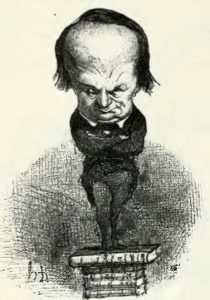
When Victor Hugo stood as a writer on his own feet he, as many of his brothers of the quill, wanted for not merely being known, that is, the popularity among simple and not too exacting folk, but also the acknowledgment on the part of masters – those having a special position in the enlightened milieu and, according to all accounts, competent in creations of human intellect. But what could be more appropriate for this purpose than the honors of French Academy famous for its achievements in the whole world? And the writer, as it was wont for that time, began to court the academicians on whose votes – no matter how obtained – his fame had been depending.
The things were working out in different ways but in large predictably until Hugo faced a very remarkable person – the philosopher, psychologist, and politician, an active participant in stormy revolutionary events Pierre Paul Royer-Collard. His peculiarity consisted not only in the profusion and variety of life experience but also in the calmness, if not to say disdain, with which he was treating the business he was, in idea, to do. In the last years of deputacy, Collard was neglecting his duties and did not go deep into what he was responsible for. Something of the kind he displayed also in the academic field. On siding with Jesuits, he not so much got keen on religious doctrines as lost the interest in all the rest and, therefore, little traced both the growth of knowledge and the disputes within seemingly close to him areas. But all this, of course, was not known to Hugo. And he hoped for meeting a refined connoisseur well up on the fresh wafts and capable of discerning the shine of true talent.
To say that the acquaintance with Collard distressed Hugo means to say nothing. But even to a greater extent it had astonished him, for ran counter to his notions of scientific world and its inhabitants. Instead of a bright-eyed sage, he found a listless and self-complacent person seeing in people around barely a trouble spot or a reason for distracting him from more important issues.
– I never read new books.
Hugo left the learned head, being as though in a daze. His mind frozen with encountering the sad reality was pierced by a single thought: in what way Collard conducts research if he reads nothing new? Does it mean that he learns of the new only from other people’s words, and even that with a delay? But they may convey the original source distorted. To boot, till the idea reaches him it becomes obsolete umpteen times. So, he can have his own view on no burning issue. But then, what is the worth of his vote? And should I strive for gaining it? Perhaps it is for the better that I have it not obtained?
Whether it was a philosophical generalization or self-soothing like the fox’ remark on sour grape is not known for certain. But going on with his thought, Hugo could not but conclude that Collard is not in a class of his own. He poses merely an extreme case. The other judges do all but the same, though not so consistently – in the sense that they read now and then what falls into their hands, – and, definitely, do not talk of that aloud. But to believe that they are omniscient and make solely fair judgments would be, for a grown man, inexcusable childishness.
On realizing this bitter truth, Hugo suddenly for himself squared his shoulders and quietly uttered: “Not only Collard’s vote but the honors themselves are worth nothing; what to worry about them for?” However, to the question whether he continues his efforts at courting academicians a firm “yes”-answer had been given. For, one thing is the lofty truth in the sight of God, and another the coarse truth of life. “Perhaps the honors”, Hugo said to himself, “will provide my heart with no comfort, but they, beyond doubt, can add comfort to my body. And on that my inward peace depends, withal.” In the mood elated by this discovery, the writer turned his steps towards home.
But just after the first bend, the treacherous notes of doubt got out of underself again. “If so”, Hugo reflected, “what I have over Collard? He merely does what I latently seek. Having obtained his portion of bodily comfort, the venerable academician avails himself of it in full swing and with complete rest in heart. It looks like he is for me a mirror from future in which I see myself – that whom I will turn into after a couple of decades. Then, have I a right to blame him?” The decisive “No” suggesting itself herefrom entered into his soul as iron. Hugo stacked his pace. His heart sank, in the foreboding of despair…
This onerous meditation is barely a fabrication, though. It would never come to Hugo. Despite his young age, he had already enjoyed the fruits of success, while before him were new shining heights to which he was impatient to climb. Would he care about dim anguishes that could poison his mind? They are the lot of old failures having lost the last illusions and hopes and feeling their mouth water at the sight of the sun giving light to others. But while basking in the sunshine, what are to you those who on their way encountered too many Collards?